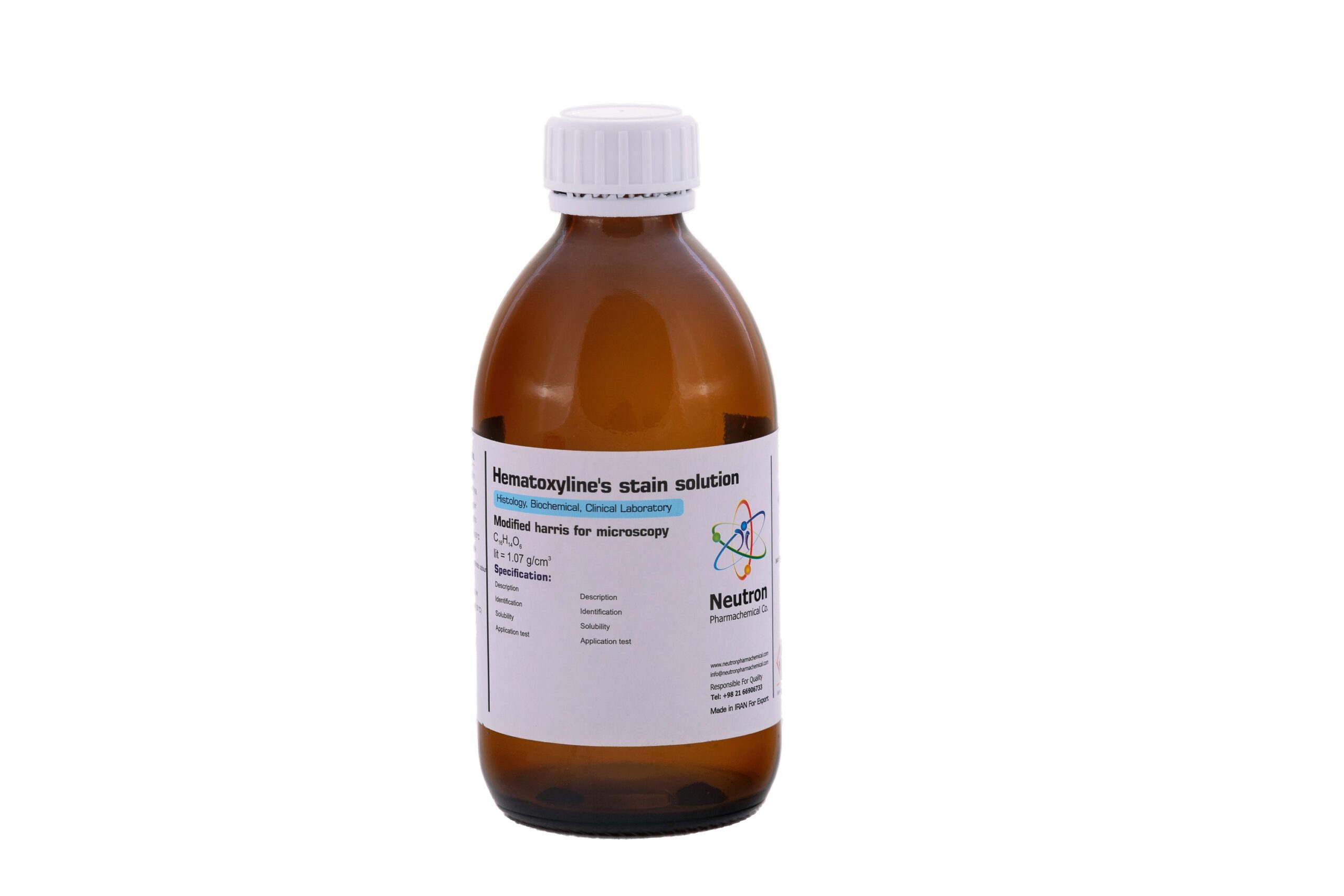
Harris’ Hematoxylin Solution is a histological staining solution used primarily for staining cell nuclei in tissue sections. It is based on hematoxylin, a natural dye obtained from the heartwood of the logwood tree. Harris’ hematoxylin is commonly used in combination with eosin in hematoxylin and eosin staining to provide clear contrast between cell nuclei and other tissue structures.
🏭⚗️ Production
Harris’ Hematoxylin Solution is prepared using hematoxylin, which is obtained from logwood. Hematoxylin is oxidized to hematein, the active coloring compound, and is commonly used with a metal mordant such as aluminum to produce a stable staining complex. The resulting solution is formulated for use in histological staining procedures.
🔬 Properties
Hematoxylin is a natural organic compound with the molecular formula C₁₆H₁₄O₆ and a molecular weight of approximately 302.28 g/mol. It is converted to hematein through oxidation, and the resulting compounds form colored complexes with metal ions. In histological staining, hematoxylin primarily stains cell nuclei blue to violet or deep purple.
🧪 Applications
Harris’ Hematoxylin Solution is widely used in histology and microscopy for staining tissue sections and identifying cellular structures. It is commonly used as the nuclear stain in hematoxylin and eosin (H&E) staining, where it stains nuclei blue or purple while eosin stains the cytoplasm and extracellular structures in shades of pink. It is also used in various cytological and histological staining procedures where clear visualization of cell nuclei is required.