

Product Code: 1.9010
Neutronco
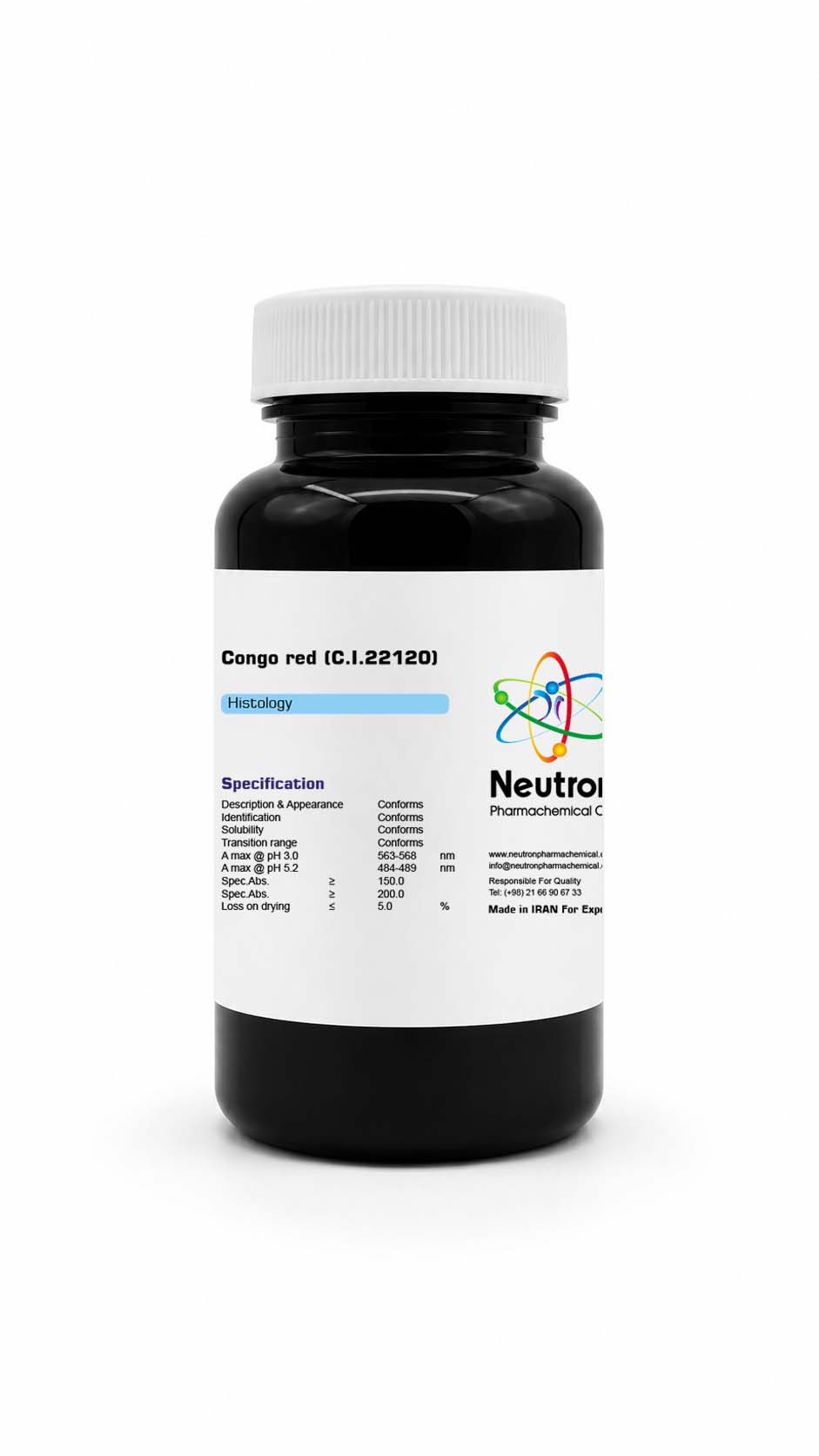
Congo red
Formula
Molar Mass
CAS Number
HS Code
Uses
| Formula | C32H22N6NaO6S2 |
| Chemical formula | C32H22N6NaO6S2 |
| Molar mass | 696.68 g/mol |
| Bulk density | ~600 -700kg/m3 |
| CAS number | 573-58-0 |
| HS Code | 32041400 |
| EC number | 209-358-4 |
| Storage | Storage at +5 to +30 °C |
| SDS | available |
| R phrase | R 45-63 |
| S phrase | S 53-45 |
| Odour | characteristic |
| Form | Solid |
| Color | reddish – brown |
| p H | ~6.7(10g/l 20 °C ) |
| Solubility in water | 25 g/l (20°C) |
| Solubility in ethanol | (20°C) slightly soluble |
| Description & Appearance | Conforms | ||
| Identification | Conforms | ||
| Solubility | Conforms | ||
| Transition range | Conforms | ||
| A max @ pH 3.0 | 563-568 | nm | |
| A max @ pH 5.2 | 484-489 | nm | |
| Spec.Abs. | ≥ | 150 | |
| Spec.Abs. | ≥ | 200 | |
| Loss on drying | ≤ | 5 | % |
Congo Red is an organic azo dye and the sodium salt of a naphthalene sulfonic acid derivative. It is water-soluble and also dissolves in organic solvents. Due to its aromatic structure, Congo Red tends to form π–π stacked aggregates, especially in high concentrations, low pH, or high salinity conditions.
🏭⚗️ Synthesis
Congo Red is synthesized through diazotization, followed by coupling two amine-substituted naphthalene sulfonic acid units with a biphenyl core. This process forms a double azo structure with strong dyeing properties.
🧪 Applications
• Amyloidosis Diagnosis: Congo Red is widely used in histology to stain amyloid fibrils. Under polarized light, stained samples exhibit a characteristic apple-green birefringence, confirming amyloid presence.
• Staining of Cell Structures: It is used to stain the cell walls of fungi, plant tissues, and the outer membranes of Gram-negative bacteria.
• Bacterial Identification: Specifically used for identifying Shigella flexneri serotype 2a by binding to its unique lipopolysaccharides.
• Type III Secretion Studies: Congo Red can induce secretion of virulence factors (IpaB and IpaC) in Shigella, useful in infection mechanism studies.
• Confocal Microscopy & Flow Cytometry: Applied as a fluorescent stain to detect protozoan cysts like Acanthamoeba and Naegleria.
• pH Indicator: Changes color from blue to red between pH 3.0–5.2, making it useful as an acidic pH indicator. It also displays metachromatic properties when binding to strongly acidophilic tissues.