

Product Code: 11.0050
Neutron
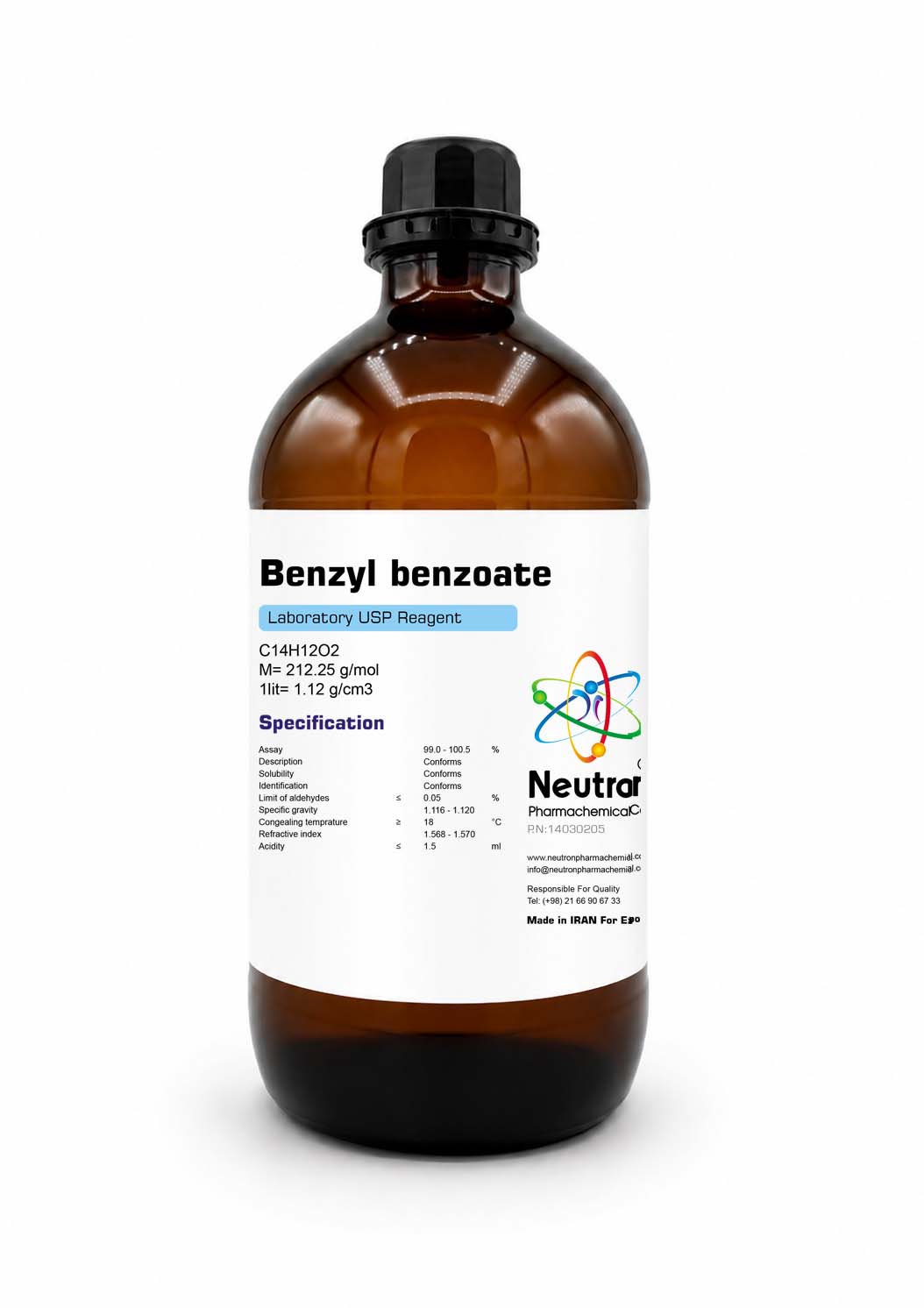
Benzyl benzoate
Formula
Molar Mass
CAS Number
HS Code
Uses
| Formula | C14H12O2 |
| Chemical formula | C6H5COOCH2C6H5 |
| Density | 1.12 g/cm3 (20°C) |
| Molar mass | 212.25 g/mol |
| CAS number | 120-51-4 |
| HS Code | 29163100 |
| EC number | 204-402-9 |
| Storage | 15 to 30 °C |
| SDS | available |
| R phrase | R 22 |
| S phrase | S 25 |
| Odour | wealy aromatic |
| Form | liqiud |
| Color | colorless |
| Ignation temprature | 480 °C |
| Solubility in water | insoluble (20°C) |
| Solubility in ethanol | freely soluble (20°C) |
| Flash point | 158 °C |
| Boiling point | 324 °C |
| Melting point | 21 °C |
| Vapour pressure | <0.1 hPa (20°C) |
| Viscosity dynamical | 10.9 mPa*s |
| Assay | 99.0 – 100.5 | % | |
| Description | Conforms | ||
| Solubility | Conforms | ||
| Identification | Conforms | ||
| Limit of aldehydes | ≤ | 0.05 | % |
| Specific gravity | 1.116 – 1.120 | ||
| Congealing temprature | ≥ | 18 | °C |
| Refractive index | 1.568 – 1.570 | ||
| Acidity | ≤ | 1.5 | ml |
Benzyl benzoate is an organic ester with the chemical formula C₁₄H₁₂O₂. It is formed from benzoic acid and benzyl alcohol and is widely used in pharmaceutical, fragrance, and industrial applications.
🏭⚗️ Production
Benzyl benzoate is produced commercially by the reaction of benzyl chloride with sodium benzoate. It can also be manufactured by transesterification of methyl benzoate with benzyl alcohol. In laboratory synthesis, it may be prepared through the Tishchenko reaction of benzaldehyde.
🔬 Properties
Benzyl benzoate is a colorless oily liquid with a faint balsamic odor. It has a molecular weight of 212.25 g/mol and a density of approximately 1.12 g/cm³. It melts at 17–20°C and boils at about 324°C. The compound is practically insoluble in water but soluble in many organic solvents.
🧪 Applications
Benzyl benzoate is widely used as a topical treatment for scabies and lice infestations. It is also used as a fragrance fixative, insect repellent, plasticizer, and solvent in a variety of industrial and pharmaceutical products.
⚠️Safety
Benzyl benzoate may cause irritation of the skin and eyes and can trigger allergic reactions in sensitive individuals. Appropriate protective equipment should be worn during handling. It should be stored in tightly closed containers in a cool, dry, and well-ventilated area.