

Product Code: 6.5080
Neutronco
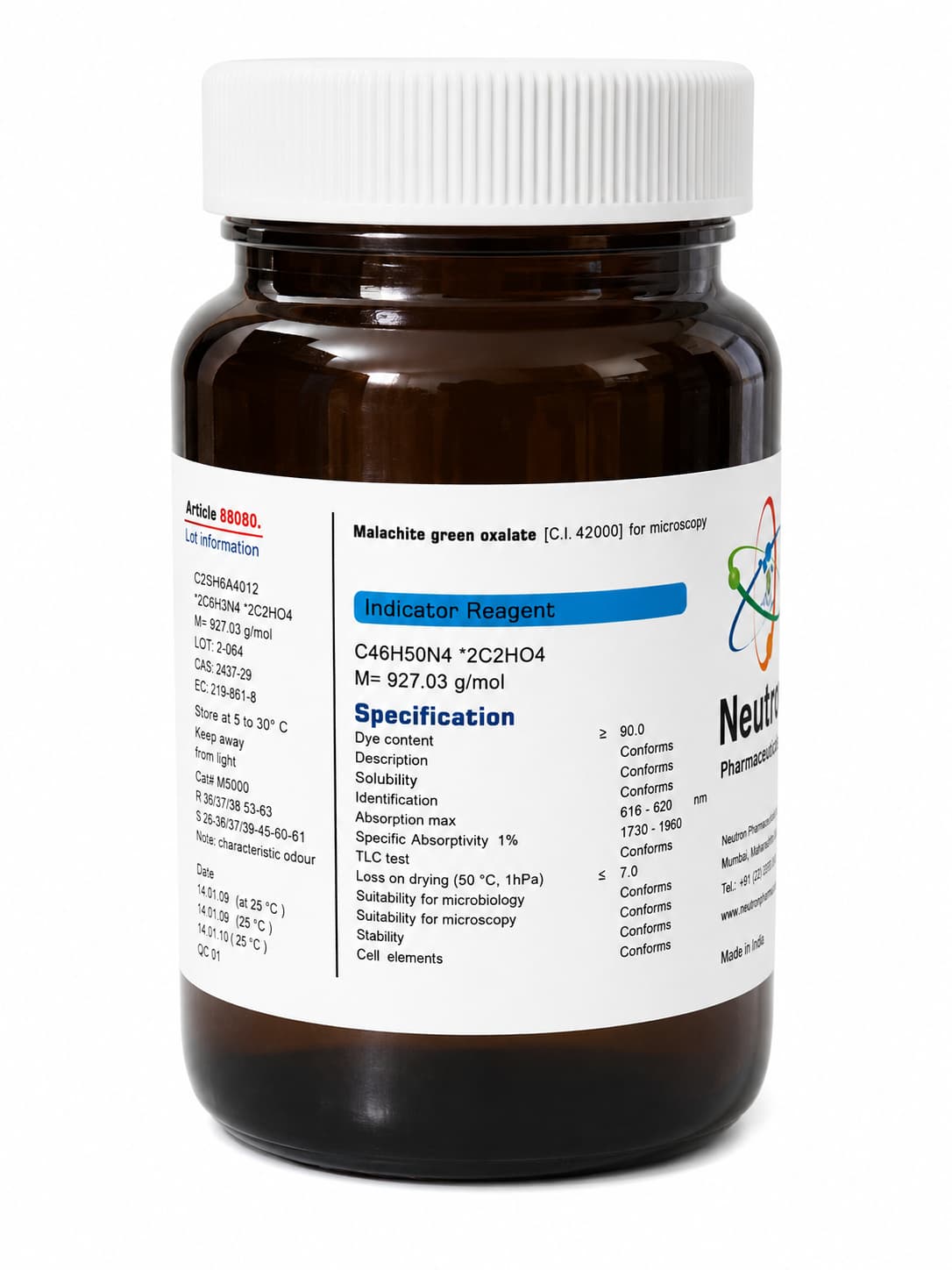
Malachit green oxalate
Formula
Molar Mass
CAS Number
HS Code
Uses
| Formula | C52H54N4O12 |
| Chemical formula | C46H50N4 *2C2HO4 |
| molar mass | 927.03 g/mol |
| CAS number | 2437-29-8 |
| HS Code | 32041300 |
| EC number | 219-441-7 |
| Storage | Store at 5 to 30° c |
| SDS | available |
| RTECS | BQ1190000 |
| R phrase | R 22-41-50/53-63 |
| S phrase | S 26-36/37-39-46-60-61 |
| Odour | weak characteristic odour |
| Form | solid |
| Color | green |
| p H value | ~2.4 (10 g/l 25 °c ) |
| solubility in water | ~110 g/l (25 °c ) |
| solubility in ethanol | ~60 g/l ( 25 °c ) |
| Melting poit | ~159°c |
| Dye content | ≥ | 90 | % |
| Description | Conforms | ||
| Solubility | Conforms | ||
| Identification | Conforms | ||
| Absorption max | 616 – 620 | nm | |
| Specific Absorptivity 1% | 1730 -1960 | ||
| TLC Test | Conforms | ||
| Loss on drying (50 °C, 1hPa) | ≤ | 7 | % |
| Suitability for microbiology | Conforms | ||
| Suitability for microscopy | Conforms | ||
| Spores | Conforms | ||
| Cell elements | Conforms |
Malachite green is an organic dye used in materials like silk, leather, and paper, and controversially as an antimicrobial in aquaculture. Despite its name, it is not related to the mineral malachite but is named for its similar green color.
🏭⚗️ Structure and Properties
As a triarylmethane dye, malachite green is typically used in its chloride or oxalate salt forms. The dye’s vivid green color results from strong light absorption at 621 nm, due to extended π-electron delocalization in its cationic form.
The alcohol form of the dye can pass through cell membranes and is converted inside cells into leucomalachite green (LMG). Only the cationic form is highly colored; the leuco and alcohol forms are nearly colorless.
🧪 Applications
• Histology: Used as a counterstain in plant tissue and for bacterial spores (Schaeffer–Fulton method).
• Biochemical assays: Employed in phosphate detection and ATPase activity measurement (e.g., BiP protein).
• Cell membrane studies: Used as a hydrophobic probe in live-cell transport studies via second-harmonic generation (SHG).
• Cell viability: Included in Alexander stain to distinguish live and dead cells.