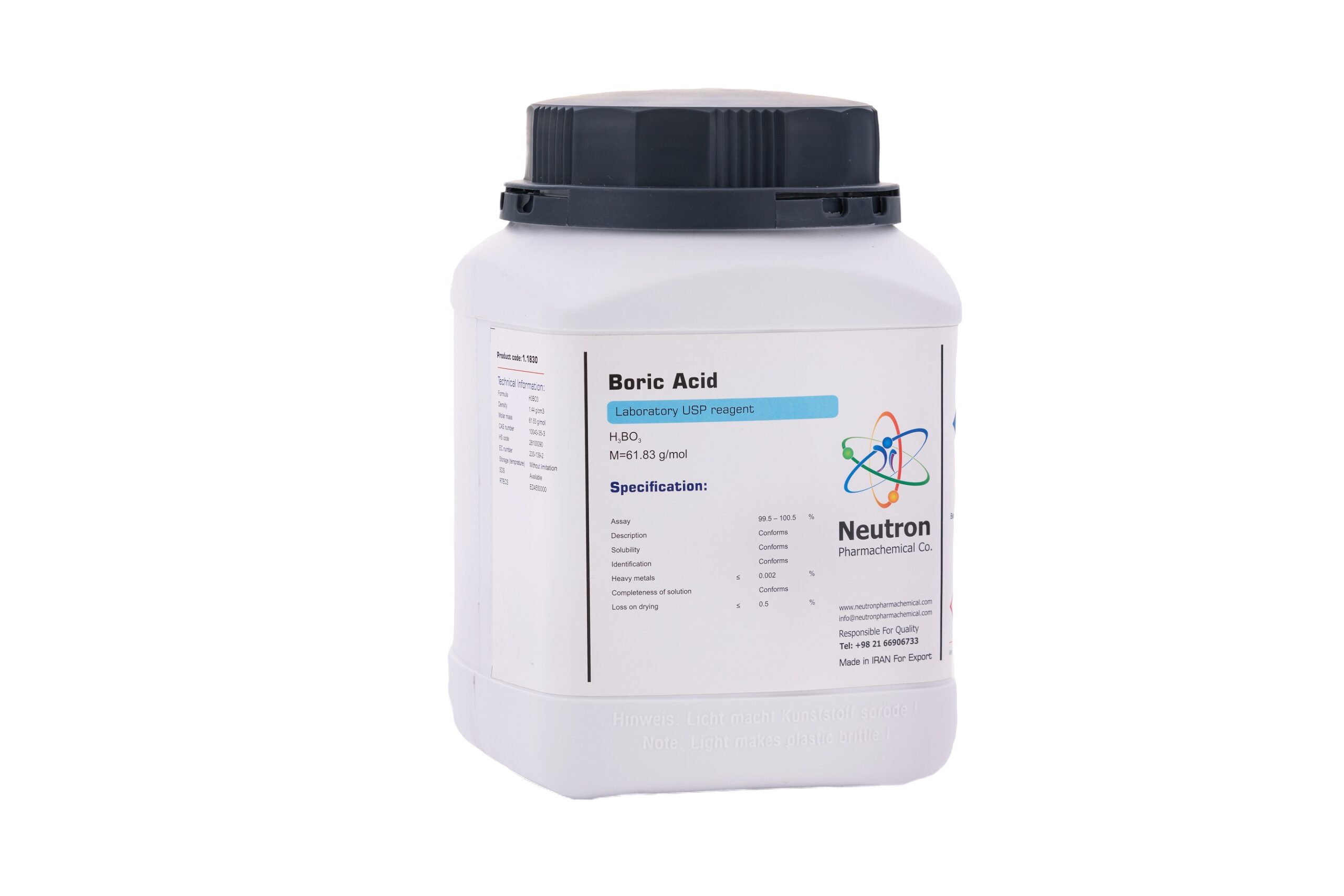


Product Code: 1.1830
Neutronco
Boric acid
Formula
Molar Mass
CAS Number
HS Code
Uses
| Formula | H3BO3 |
| Density | 1.44 g/cm3 |
| Molar mass | 61.83 g/mol |
| CAS number | 10043-35-3 |
| HS code | 28100090 |
| EC number | 233-139-2 |
| Storage (temprature) | Without limitation |
| SDS | Available |
| RTECS | ED4550000 |
| Assay | 99.5 – 100.5 | % | |
| Description | Conforms | ||
| Solubility | Conforms | ||
| Identification | Conforms | ||
| Heavy metals | ≤ | 0.002 | % |
| Completeness of solution | Conforms | ||
| Loss on drying | ≤ | 0.5 | % |
Boric acid (B(OH)₃) is a weak inorganic acid of boron that appears as a white, odorless crystalline solid. It is soluble in water and commonly used in industrial, laboratory, and household applications as an antiseptic, insecticide, flame retardant, and pH buffer.
🏭⚗️ Production
Boric acid is commonly produced by reacting borax (sodium tetraborate) with a mineral acid such as hydrochloric acid. It can also be obtained as a byproduct from the hydrolysis of boron compounds like boron trihalides or diborane.
🔬 Properties
Boric acid is a white crystalline solid with no distinct odor. It has a melting point around 170.9 °C but decomposes before boiling. It is moderately soluble in cold water and highly soluble in hot water. The solution is weakly acidic and acts as a Lewis acid, capable of forming complexes with hydroxide ions or alcohols. Its density is approximately 1.435 g/cm³. When dissolved in water, it does not fully dissociate like strong acids; instead, it accepts hydroxide ions, forming tetrahydroxyborate anions. The acidity is mild, making it useful in pH buffering systems.
🧪 Applications
• Industrial uses: Used in glass and fiberglass production, ceramics, flame retardants, and welding fluxes
• Laboratory: Functions as a mild antiseptic and buffer in chemical solutions
• Household: Applied in pest control as an insecticide against ants, cockroaches, and termites
• Nuclear industry: Acts as a neutron absorber in pressurized water reactors
• Cosmetics and pharmaceuticals: Included in eye washes, powders, and creams for its antibacterial properties